The Western Association of Schools and Colleges - WASC
The US accrediting body popular in Asia for many international schools.

WASC is one of the main accrediting bodies in the U.S. Its school division, the Accrediting Commission for Schools (ACS WASC), accredits primary and secondary schools in California, Hawaii and the US Pacific territories.
It also accredits a large number of international schools, especially in Asia.
Accreditation
Accreditation provides a third party endorsement that a school is doing what is claims to do, does it to a reasonable standard, and has a working process for getting better.
Worth noting international schools (outside the US) still need local approval to operate with WASC requiring that approval as a condition of entry.
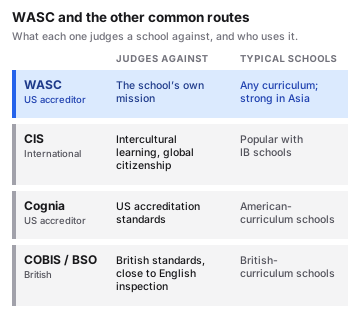
WASC does not prescribe a curriculum. It judges a school against the school's own stated purpose. That is why an American-curriculum school, an IB school and a British-curriculum school can all hold WASC accreditation. The question is - "is this school delivering the programme it claims to offer, to a good standard?"
Purpose and learner outcomes
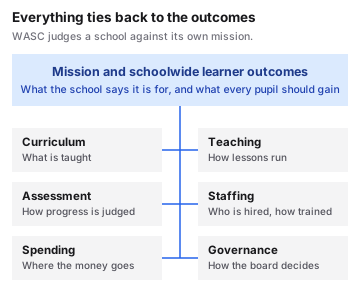
Everything in the WASC process runs back to two things: the school's mission and a short set of schoolwide learner outcomes. The first critera expect a school to have a clear vision and mission, and adopted learner outcomes that reflect global competencies that form the basis of the educational programme for every student.
In practice, a school has to show that its curriculum, teaching, assessment, staffing, spending and governance all connect back to those outcomes. Schools often write attractive mission statements that nobody uses. WASC's process is built to expose that gap.
How the process works
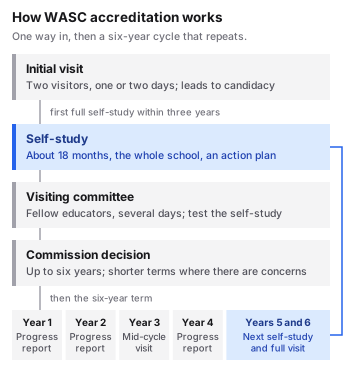
Initial visit. A school new to WASC first hosts a small team. A two-member team spends one or two days trying to understand the school's purpose, programme and operations against the WASC criteria. The outcome can be candidacy or initial accreditation. Either way, the school must then act on the committee's recommendations and complete its first full self-study by the end of the third year.
Self-study. This is the heart of WASC and what distinguishes it from inspection-style systems. The school examines itself in depth, using the WASC criteria, which cover organisation and leadership, curriculum, teaching, assessment, student support and resources. Teachers, leaders, governors, parents and often students take part in focus groups. The school analyses its own data on student achievement and writes a candid report. This work normally runs over roughly 18 months before the visit and produces a three-to-five-year schoolwide action plan. A self-study that only records strengths is a weak one, and experienced visiting committees notice.
The visiting committee. A team of practising educators from other schools then visits for several days. They observe lessons, read student work, interview staff, meet parents, and test the claims the self-study makes. Their job is to confirm or challenge the school's own analysis and to sharpen its action plan. They write a report with a confidential recommendation on accreditation status.
The decision. The Commission makes the final decision on accrediation. The standard cycle is six years. A full six-year status goes to schools where there is compelling evidence that they need little additional support to deliver high-quality learning and carry out their action plan. Schools with more serious concerns receive shorter terms, closer monitoring, or in serious cases probation or loss of accreditation.
Between visits. International schools complete a mid-cycle progress report and host a two-day mid-cycle visit, with annual interim progress reports in years one, two and four.
For international schools
WASC serves several practical purposes.
University recognition. A WASC-accredited high school diploma is readily accepted by American universities, and widely recognized by universities elsewhere. For a school issuing its own diploma rather than relying only on external qualifications like the IB Diploma or A levels, this recognition is critical.
Credit transfer. International families often move. When a student moves from an accredited school in Seoul to one in California or Singapore, accredited status makes transcripts and credits much easier to accept.
Quality assurance where local regulation is thin. In many countries, the ministry regulates international schools lightly or checks mainly for compliance. Accreditation gives parents and staff an independent signal that a credible outsider has examined how it really works.
Regional weight in Asia. WASC has a long presence in the region. It has worked with international schools, particularly in Asia, since the late 1960s. The commission includes a representative from the East Asia Regional Council of Schools (EARCOS), and it collaborates with some foreign ministries of education, such as Thailand's.
Joint processes. Many international schools hold more than one accreditation or authorisation. WASC offers a formal joint pathway with the Council of International Schools (CIS) and the IB, so a school can complete one integrated process that satisfies several bodies at once. This matters because a full self-study is time-consuming, and running three separate ones in overlapping cycles is a real burden for a staff.
How WASC compares with other common options
- CIS International by design. It places heavy weight on intercultural learning and global citizenship, and it is popular with IB schools.
- Cognia, formerly AdvancED, is the other major US-based accreditor. The common route for American curriculum schools abroad.
- British curriculum schools often pursue COBIS membership and British Schools Overseas inspection. These are closer to the English inspection model and judge the school more directly against British standards.
What accreditation says about a school
WASC accreditation tells a parent several things: the school is properly constituted and legally approved, it has a coherent purpose, peers have examined it against published criteria, and it is committed to a monitored improvement plan.
Some critics say the process can become document heavy and that its peer-review nature makes it gentler than government inspection. Supporters argue the self-study pushes a staff to examine their own practice seriously in a way that a government inspection may not.
WASC schools on Prospectus
| School | Curriculum | Fees a year (USD) |
|---|---|---|
| Hong Kong (2) | ||
| Canadian International School of Hong Kong | Canadian · IB | 18,200–33,300 |
| Hong Kong International School | American | 29,500–34,700 |
| Jakarta (6) | ||
| British School Jakarta | British · IB | 8,820–31,200 |
| Jakarta Intercultural School | American · IB | 17,000–35,200 |
| North Jakarta Intercultural School | IB | 3,980–14,900 |
| Sekolah Pelita Harapan Lippo Cikarang | British · IB | 6,700–13,900 |
| Sekolah Pelita Harapan Sentul City | IB · British | 2,170–9,010 |
| Springfield School | British | 2,140–4,160 |
| Kuala Lumpur (2) | ||
| Mont'Kiara International School | American · IB | 8,940–32,000 |
| The International School of Kuala Lumpur | American · IB | 17,200–35,100 |
| Singapore (6) | ||
| Dover Court International School | British · IB | 23,600–37,600 |
| Dulwich College (Singapore) | British · IB | 29,400–46,300 |
| Singapore American School | American | 34,800–43,600 |
| Stamford American International School | American · IB | 24,100–43,900 |
| UWCSEA Dover Campus | IB · British | 30,600–39,100 |
| UWCSEA East Campus | IB · British | 30,600–39,100 |
Compare WASC schools
Verified fees, curricula and admissions for every WASC school we list.
FAQ
What does WASC accredited mean?
An outside body has checked that the school does what it says it does, to a reasonable standard, and has a working process for getting better. WASC judges the school against its own mission, not a set curriculum.
How long does WASC accreditation last?
Up to six years. Schools with concerns get shorter terms, closer monitoring or probation, and international schools report in between and host a mid-cycle visit.
Is WASC a curriculum?
No. WASC accredits schools teaching American, IB, British and other curricula, and checks that each delivers the programme it claims to offer.
What is the difference between WASC and CIS?
Both accredit international schools. CIS is international by design and weighs intercultural learning and global citizenship; WASC judges a school against its own mission. Many schools hold both through one joint process.
Do universities recognise a WASC-accredited diploma?
American universities readily accept it, and universities elsewhere widely recognise it. It matters most for schools that issue their own diploma.