The American curriculum: The US school system from kindergarten to the AP
Elementary, middle and high school. The diploma and the AP.


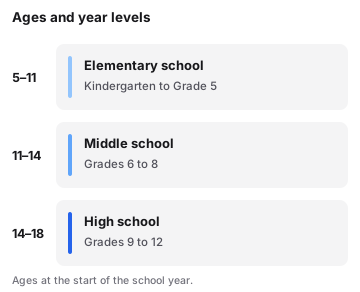
The first thing to note is that there is no national curriculum in the US. Education is controlled at state and district level, and what's taught across different parts of the US can vary considerably.
Nonetheless there are commonalities. Each state uses the same
- grades from kindergarten to Grade 12,
- system of credits and grade point averages, and
- high school diploma at the end, with AP courses and exams as the optional top layer in the final two years.
Most states also teach to broadly the same standards: some version of the Common Core in English and maths, and the Next Generation Science Standards in science. Schools are accredited by regional bodies such as Cognia, WASC and the Middle States Association rather than by government, which is what an American school abroad relies on too.
High school graduation requirements
Students take 6 to 8 subjects a year for the four years of high school, earning one credit per subject per year. Around 22 to 26 credits are needed to graduate, and the required subjects account for roughly two-thirds of them.
| Subject | Years required |
|---|---|
| English | 4 |
| Maths | 3 or 4 |
| Science | 3 |
| Social studies | 3 |
| PE, arts, a foreign language | required; length varies by state |
| Electives | the remaining slots, chosen by the pupil |
A sample four-year timeline
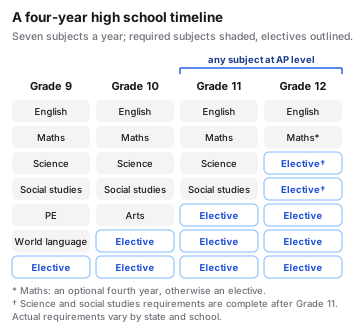
Rather than narrowing to three or four subjects at 16, a pupil keeps the full spread and takes harder versions of them. Every subject in Grades 11 and 12 is offered at two or three levels, and the pupil picks the level:
- Regular (sometimes "college prep"): the standard course, e.g. English 11, Precalculus, Physics, US History.
- Honors: the same course, faster and deeper, e.g. Honors English 11, Honors Precalculus. Set and graded by the school.
- AP: the university-level version with the College Board exam in May, e.g. AP English Language, AP Calculus AB, AP Physics 1, AP US History.
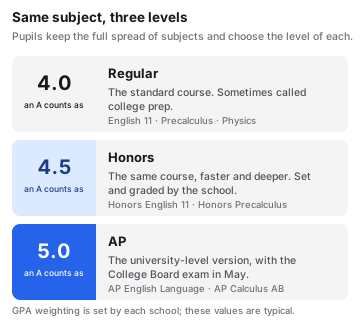
So a Grade 11 timetable might be: AP English Language, Honors Precalculus, Physics (regular), AP US History, Spanish 3, Psychology, Jazz Band. The pupil who isn't taking AP does exactly the same subjects at regular or honors level, and the transcript shows the level next to each grade. Schools weight the GPA for it: an A in a regular course is 4.0, in honors typically 4.5, in AP 5.0.
The electives that have no AP version are the practical and creative ones: journalism, drama, robotics, business, band, photography. Those are simply taken or not.
AP exams are marked by the College Board on a scale of 1 to 5, and a 4 or 5 earns credit at most US universities. Some American schools abroad offer the IB Diploma in place of AP for the last two years.
Performance and assessment
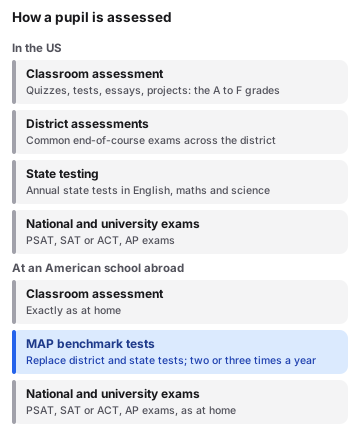
Performance and assessment operate through a combination of classroom evaluation, district benchmarks, and state-mandated standardised testing. Taking the San Diego Unified School District in California as an example, a pupil's performance is measured in four layers:
- Classroom assessment. Set and marked by the teacher: quizzes, tests, essays, projects and end-of-term exams. These produce the A to F grades on the report card and feed the GPA.
- District assessments. Common end-of-course exams across the district's schools, used to keep standards level between schools and to decide placements and support.
- State testing. Every spring, California pupils in Grades 3 to 8 and Grade 11 sit the state's online tests in English and maths, with science in Grades 5, 8 and once in high school. These measure the school against state standards; they don't decide a pupil's grade or progression.
- National and university exams. Voluntary and external: the PSAT in Grade 10 or 11, the SAT or ACT for university admission, and AP exams for university credit.
An American school abroad has no state or district above it, so layers 2 and 3 fall away. Most replace them with the MAP tests, a US benchmark exam sat two or three times a year, and keep layers 1 and 4 exactly as at home.
University entry
Based on GPA, course rigour, standardised tests (SAT/ACT, now optional at many universities), essays, recommendations, and extracurriculars — a holistic file rather than an exam grade threshold.
The optional-tests point has shifted this year: Harvard, Yale, MIT, Stanford and most of the Ivy League require SAT or ACT scores again for 2026 entry, while the majority of US universities stay test-optional.
Universities outside the US read the file differently. The UK asks for AP results: Oxford wants four at grade 5, or three plus an SAT of 1480; Cambridge five at 5; most UK universities three at 4 or 5.
Compare American-curriculum schools
Fees, ages and admissions for every American school we list, city by city.