What is the British curriculum? The English system from 3 to 18, explained
England's national framework. Key Stages, year groups, IGCSEs, A-levels, Cambridge, Edexcel and Oxford, explained.

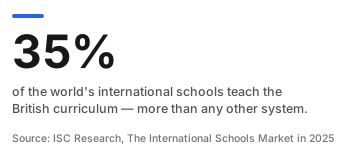
The "British curriculum" has become the most popular choice among the world's international schools.
But what is it really?
What it is
The National Curriculum for England (ENC), when we include the Early Years Foundation Stage and A-levels, sets out what children in England learn from 3 to 18: which subjects, in what order, to what standard. It was created by the Education Reform Act 1988 so that every school in England worked to a single framework and every child's progress could be measured against it. Scotland, Wales and Northern Ireland each run different systems, hence the use of "English", not "British".
International schools have adopted it for three reasons. It is sequential: a child can move between English-curriculum schools anywhere in the world and pick up where they left off. It ends in externally examined qualifications (IGCSEs and A-levels) recognised by universities everywhere. And it comes with a deep supply of UK-trained teachers who know how to teach it.
Key Stages and year groups
The curriculum is organised into Key Stages, and children are grouped strictly by age. The school year runs from late August or September to June or July.
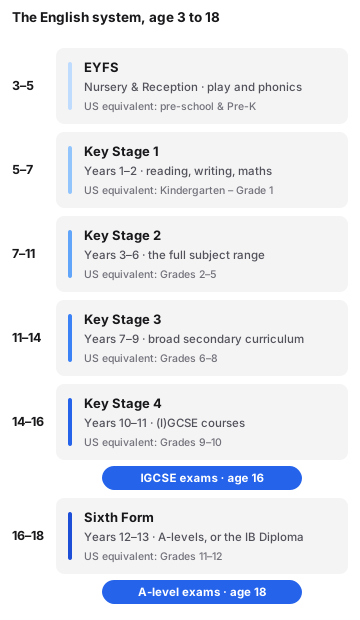
Two details catch parents out. English year groups run one ahead of American grades: a Year 4 child is the age of a Grade 3 child, so a school move across systems can look like being "held back" when it isn't. And entry is by birthday cut-off — a child joins Year 1 in the September after turning five, so an August-born child is the youngest in the class by nearly a year.
What children learn
English, mathematics and science are the core subjects, taking the largest share of the timetable from Year 1 to Year 11. Around them sit the foundation subjects: history, geography, art, music, design and technology, computing, physical education and a language.
Reading is taught through systematic phonics from Reception — children learn the sounds letters make and blend them into words, rather than memorising words whole. Most children read independently by six or seven, earlier than in many other systems, because formal instruction starts younger.
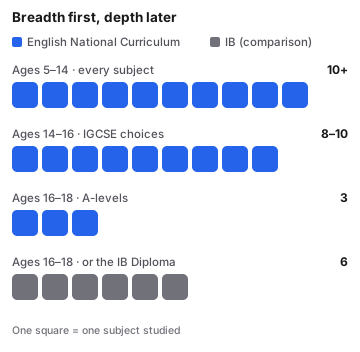
The defining shape of the curriculum is breadth first, depth later. Children study the full range of subjects to 14, choose their (I)GCSE subjects for the final two years of compulsory schooling, then narrow again, sharply, at A-level. It is the mirror image of the IB, which keeps six subject groups running to 18.
The qualifications
At the end of Year 11, students sit IGCSEs: typically eight to ten subjects, each examined and graded separately. The I stands for International: these are GCSEs adapted for schools outside the UK, with the England-specific content loosened, and universities treat the two as equivalent.
In the Sixth Form, students take A-levels: normally three subjects, studied in depth for two years. This is the sharpest narrowing in the system. A 16-year-old chooses three doors and closes the rest. The reward is depth: A-levels remain the standard route into UK universities, are accepted across Australia, Canada, Hong Kong and Singapore, and earn course credit at many American ones.
Not every English-curriculum school finishes with A-levels. A significant number switch to the IB Diploma for the final two years, or run both tracks side by side. It changes the character of the Sixth Form entirely, so it is worth knowing which model a school runs before the child is 14.
Cambridge, Edexcel and the other boards
There is sometimes confusion in terminology around a "British school", the English National Curriculum, and exam boards such as Cambridge, Edexcel and OxfordAQA.
The ENC sets out the curriculum. Exam boards like Cambridge or Edexcel take that curriculum and set out syllabuses (a syllabus is the detailed plan of what is taught and examined in a subject) and set the exams. So for maths in Year 9 under the English National Curriculum, you may be doing maths under the Cambridge, or Edexcel, or OxfordAQA maths syllabus, with an exam set by the relevant board at the end.
Three exam boards operate internationally. Cambridge International, part of the University of Cambridge, is the largest. It brands the earlier years as "Cambridge Primary" and "Cambridge Lower Secondary", so some schools describe themselves as teaching "the Cambridge curriculum". Pearson Edexcel is its main competitor, with International GCSEs and International A-levels. OxfordAQA, a venture between the AQA board and Oxford University Press, is the third. The remaining UK boards (AQA at home, OCR, WJEC) examine only domestically, so their names rarely appear abroad.
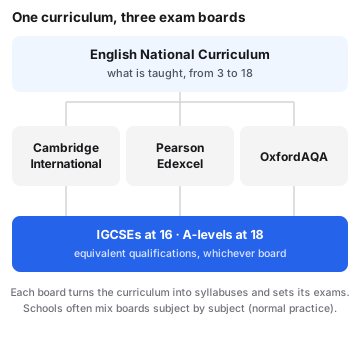
Schools routinely mix boards subject by subject (Cambridge for the sciences, Edexcel for maths), chasing the syllabus that suits their teaching. This is normal practice, not a warning sign.
Adoption of the ENC overseas
The UK government runs an accreditation framework for exactly this: British Schools Overseas (BSO). To earn it, a school is inspected by an approved inspectorate (usually ISI, which also inspects England's independent schools) and has to reach a serious standard across the board: teaching and learning, school management, safety and safeguarding. Schools that pass are accredited BSO schools, and most join COBIS, the association of British schools overseas.
Adaptation to the host country varies. Most schools change little: local language and history added to the English core. Some governments require far more: in mainland China the state curriculum is compulsory for Chinese pupils up to 15, so British schools there either teach only foreign-passport children or adapt much more deeply.
Most families choosing the English National Curriculum have never lived in England. What they are choosing is the most recognised school system in the world; qualifications that open universities everywhere; a well-developed international ecosystem, from teaching faculty to accreditation to curriculum support; and the British education brand — Eton, Oxford and Cambridge, the same A-levels.
Compare British-curriculum schools
Verified fees, curricula and admissions for every listed school.