The IB explained: PYP, MYP and the Diploma
From its roots in Geneva, how the IB works from 3 to 19.
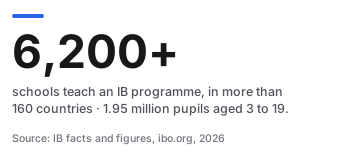
The International Baccalaureate is arguably international schooling's second great brand. Taught in more than 6,000 schools across the world.
Here is how it fits together, from a three-year-old's classroom to the IB diploma.
What is it?
The IB is run by the International Baccalaureate. This is a non-profit foundation set up in Geneva in 1968. It was built by international school teachers with a practical problem. Their pupils moved between countries, but no national qualification travelled with them. The answer was a diploma that would be accepted by universities everywhere.
Today the IB Foundation writes the curriculum frameworks, authorises and inspects the schools that teach them, trains the teachers, and sets and marks the final examinations. Where the British system divides those jobs between a government and competing exam boards, the IB keeps them inside one organisation.
The programmes
The IB runs four programmes. A school may teach any combination of them.
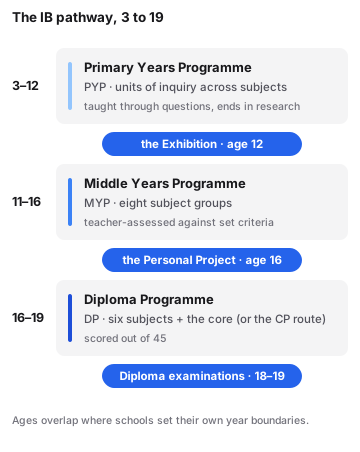
The Primary Years Programme (PYP, ages 3–12) organises learning into "units of inquiry" (questions children investigate across subjects) and ends with a public Exhibition of each child's own research.
The Middle Years Programme (MYP, 11–16) carries the approach into eight subject groups and closes with the Personal Project, a self-chosen piece of extended work.
The Diploma Programme (DP, 16–19) is the original 1968 qualification and still the flagship - two years, six subjects, final examinations.
A fourth route, the Career-related Programme (CP, 16–19), pairs a smaller set of Diploma courses with vocational study.
Most IB schools in the world teach the Diploma alone, on top of another curriculum lower down.
How it's taught
The IB's method is inquiry: units start from questions, and children build towards concepts through their own investigation, with the teacher steering rather than dictating. Ten "learner profile" attributes (inquirers, thinkers, risk-takers and others) run through everything the organisation publishes, and schools take them seriously: you will find them on report cards, in assemblies and in teachers' job adverts.
Two points to make on delivery.
First, the PYP and MYP are frameworks: the IB organisation sets the approach and the standards. Each school chooses much of the content. So two MYP schools can teach noticeably different material to the same standard.
Second, exams. Until 16, marks come from a pupil's own teachers, graded against the IB's published criteria; the IB checks a sample of the big end-of-MYP projects. A formal MYP exam exists, but few schools use it. The first external examinations most IB pupils sit are the Diploma's, at 18.
What teachers say
Teachers are blunter than brochures. The refrain, from fans and critics alike: the IB is only as good as the school running it.
The Diploma earns respect for depth; one veteran of all three big systems reached for Churchill: the worst system, except for all the others. TOK is "the coolest class no one wants to take".
The MYP divides staffrooms: some love the inquiry, plenty tire of its paperwork and jargon. The workload is no myth.
And the same line keeps coming back about graduates: they return calling it the best possible preparation for university.
The Diploma
The Diploma is a two-year course with six subject groups:
- literature in the pupil's best language,
- a second language,
- a humanities subject,
- a science,
- mathematics, and
- the arts (with the arts slot swappable for a second science or humanity).
Three subjects are taken at higher level, three at standard level, so an IB pupil keeps languages, sciences and maths running to the end of school.
It is the widest sixth-form course in mainstream use, where its British rival narrows to three or four chosen A-levels.
Around the subjects sits the core, and the core is what makes the Diploma feel different:
- Theory of Knowledge, a course in how knowledge is built
- The Extended Essay, four thousand words of self-directed research; and
- CAS — creativity, activity, service — logged across both years.
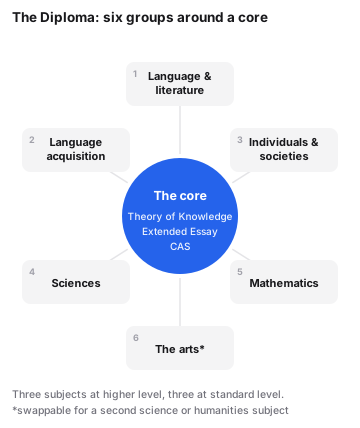
Each subject is graded 1–7, the core adds up to three points, and the whole Diploma is scored out of 45. The pass mark is 24.
What results mean
The worldwide average Diploma score is around 30. Mid-30s is a good result. Anything over 40 is excellent, and the full 45 is rare. Fewer than one candidate in a hundred gets there in a typical year.
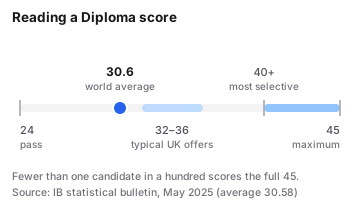
UK university offers usually fall between 32 and 36, rising past 40 for the most selective courses. American universities read the whole application, and most give course credit for higher-level subjects passed at 5 or better. Universities in Australia, Canada and across Europe and Asia accept the Diploma directly.
Schools like to publish their average score. Compare it with the worldwide 30.
"IB school" can mean four different things
A school can be authorised for any of the four programmes, in any combination. It might mean the full continuum from age 3 or the Diploma alone, bolted onto a different curriculum lower down. It might be the PYP in a primary school with GCSEs waiting upstairs.
Authorisation itself has two stages. A candidate school is preparing to teach a programme and may say so in its marketing. An authorised IB World School has been through the IB's evaluation and can deliver it. This is public information. The IB organisation lists every authorised school and its programmes on ibo.org.
To the extent that parents choose the IB over another curriculum, they pick it because it travels and is a well-regarded qualification, accepted by universities almost everywhere. It suits pupils who would rather keep maths, a language and a science going than pick three subjects at 16. And a lot of pupils join only at 16 anyway, when a British, American or Australian school switches to the Diploma for the final two years.
Compare IB schools
Verified fees, curricula and admissions for every listed school.