Policy · Incheon
Unlicensed international school in Songdo keeps teaching past its eviction deadline
The school owes about 400 million won in rent, and Korea's education ministry admits it cannot physically stop schools like it from holding classes.
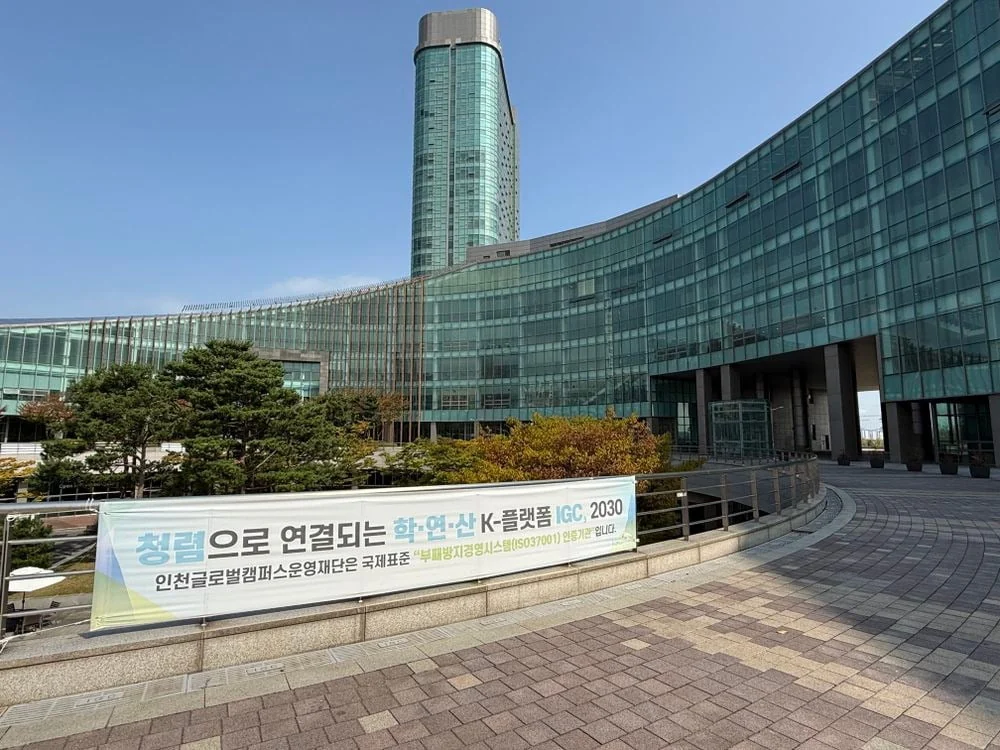
An unlicensed international school on the Incheon Global Campus in Songdo kept teaching after its eviction deadline passed on 30 October 2026, and says it will go to court to stop its lease being ended.
The campus's operating foundation served notice on 8 October. It says the school, which presents itself as the Asian branch of a US private school, owes about 400 million won (about US$290,000) in rent. An official for the foundation said it would respond legally and recover the money.
The school accuses the campus of infringing pupils' right to learn and obstructing its operations. It has not been named in reports.
Parents and staff
Families pay 22 million to 30 million won a year, about US$16,000 to US$22,000. Parents and staff say about 190 million won in tuition refunds and wages is owed, and have filed a fraud complaint against the operators with Yeonsu police. The school has moved its refund date from 31 October to 12 November.
Some pupils have already left for other unlicensed schools in Incheon and in Gangnam, Seoul. The school itself took in about 10 pupils when an unlicensed school in Siheung closed.
The case reached parliament on 23 October, when lawmakers raised reports that relatives of Cha Jeong-in, chair of the National Education Commission, were involved in running the school. The operator had been switched to a cooperative with about 10 million won in capital.
Limits of enforcement
The Ministry of Education found 97 unlicensed international schools among 213 unregistered education facilities it inspected between December 2025 and March 2026. Of those, 83 are in the capital region:
| Region | Unlicensed international schools |
|---|---|
| Gyeonggi | 39 |
| Seoul | 33 |
| Incheon | 11 |
Incheon's education office finished a third round of site checks on 21 October. Education Minister Choi Kyo-jin told the National Assembly on 23 October that criminal complaints against facilities still operating would follow in November.
Running an unlicensed school carries up to three years in prison or a fine of up to 30 million won. From 20 November, a facility that ignores a closure order can also be fined repeatedly. No closure order has yet been issued anywhere in the country.
A ministry official said that even after a complaint, it has no power to physically stop a school that keeps holding classes. The ministry commissioned research in September on stronger penalties.
Demand has not gone away. In a survey of 235 households by the Global Education Alliance, a parents' group, 7.7 per cent said they would move their children to an ordinary Korean school if their unlicensed school closed. Licensed international schools in Incheon report a rise in enquiries about admissions.
Sources: 3 pages
- [단독] 인천 미인가 국제학교, 퇴거 요구에도 버티기…제재는 '유명무실', Hankyung
- '4억 내고 나가' '못 나가'…'학비 3000만원' 국제학교 배짱, Hankyung
- 학비 3000만원 내고 체육관도 못 쓴다…수상한 국제학교, Hankyung
More in Policy
More- 2 November
Dubai Arabic teachers need KHDA approval to teach Islamic Education to under-sixes
A KHDA guide sets who may teach the subject to Muslim children aged four to six, in which language, and what schools must keep for inspectors.
Dubai
Dubai · 2 November
- 2 November
Da Nang police say English centre posed as American school for 200 pupils
The centre was licensed only to teach children English. Its director has been charged with fraud and has confessed, police say.
Da Nang
Da Nang · 2 November
- 2 November
PowerSchool hack exposed 15,666 records at three Seoul international schools
The three schools still use the hacked records system, and Seoul's education office has answered with letters and a self-checklist.
Seoul
Seoul · 2 November
- 1 November
Thailand's commerce ministry backs international schools' push for 120,000 pupils
Trade officials will market Thai international schools abroad, with South Korea, Japan and Myanmar as the first targets for new families.
Bangkok
Bangkok · 1 November