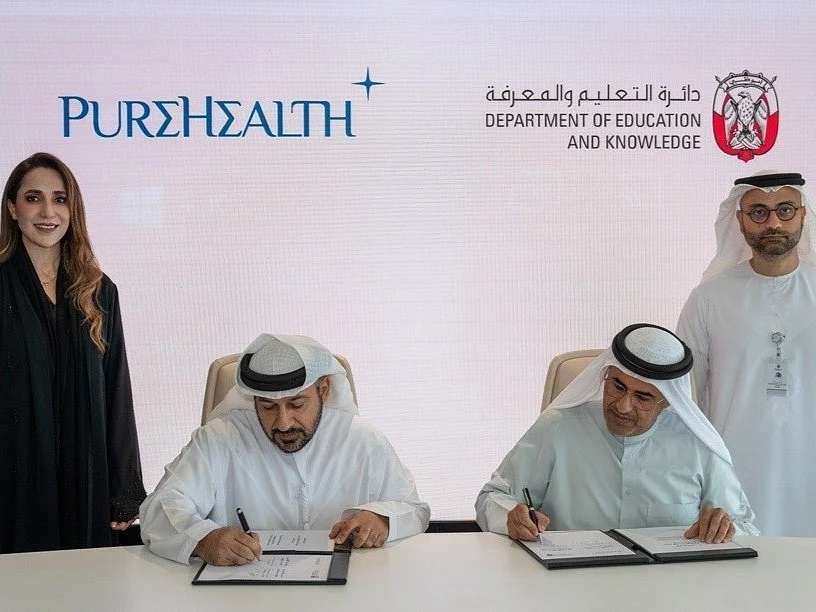
Abu Dhabi's education regulator signed an agreement with healthcare group PureHealth on 11 November 2026 to train up to 250 Emiratis a year for jobs supporting pupils with additional learning needs in private and charter schools.
The scheme, run by the Department of Education and Knowledge (ADEK), has two routes.
| Route | Who it is for | Yearly target |
|---|---|---|
| New inclusion assistants | UAE nationals out of work | Up to 120 certified |
| Inclusion assistant to inclusion teacher | Emiratis already working as inclusion assistants | Up to 130 upskilled |
Training lasts six months. Sakina, PureHealth's mental health division, delivers the clinical part, covering psychology, occupational therapy, speech and language therapy and behaviour support. Trainees then do supervised placements in private and charter schools across the emirate.
Mubarak Hamad Al Mehairi, ADEK's undersecretary, signed for the regulator. "Through our partnership with PureHealth, we are opening promising new career pathways for Emirati talent," he said. Saeed Al Kuwaiti, group chief executive of SEHA, signed for the health side.
The scheme sits under ADEK's Emiratisation policy for private schools and its Madad and Be a Teacher programmes. Later partnerships with universities could let graduates go on to qualifications in special education and allied health.
ADEK's inclusion policy
The two job titles come from ADEK's inclusion policy, one of 39 policies the regulator introduced in September 2024, with schools given until September 2026 to comply.
The policy renamed shadow teachers as inclusion assistants. A pupil can have one in class only where evidence shows the child needs that help for at least half of the school day. Inclusion teachers are qualified teachers who can lead or co-teach lessons and write individual learning plans.
Schools cannot turn a child away simply for lacking capacity. They must send ADEK written evidence, and ADEK can overturn the refusal. "They will overturn their decision to reject the student and mandate them to accept," Sylvie Wald, director of ADEK's education policy office, said when the policy was explained in March 2025.
The announcement does not say who pays for the training or what trainees will earn.
Sources: 2 pages
More in Policy
More- 17 November
Dubai schools must report pupils absent five days in a row and keep staff off personal phones
Further detail from KHDA's new safeguarding framework treats unexplained absence as a warning sign and limits how staff may contact pupils.
Dubai
Dubai · 17 November
- 14 November
Dubai private schools must report every bullying case to KHDA under new safeguarding rules
Each school needs a board-level safeguarding governor within nine months, and a pupil's record will follow them if they move school in Dubai.
Dubai
Dubai · 14 November
- 14 November
Hong Kong bill would make international school teachers renew a licence every three years
The Education (Amendment) Bill 2026, gazetted on 13 November, adds practising certificates and a lifetime teaching ban for national security convictions.
Hong Kong
Hong Kong · 14 November
- 13 November
Qatar sets graded penalties for private school breaches, up to cancelling licences
A new ministry rulebook covers fees, admissions, staffing and accreditation at Qatar's 354 private schools and kindergartens, with penalties scaled to how serious a breach is.
Qatar
Qatar · 13 November