Accreditation, membership, curriculum and licensing
What the CIS, COBIS, BSO, FOBISIA, IB and Cambridge logos on an international school's website mean, and how to check them.

An international school's website usually carries a row of logos: CIS, COBIS, BSO, FOBISIA, the IB, Cambridge. Let's go through what the most popular ones mean.
CIS, NEASC, WASC and the UK government's BSO scheme provide outside accreditation: they inspect the school against written standards.
EARCOS, COBIS and FOBISIA are examples of associations. They give their schools a wide range of benefits, from sports and music competitions to training, conferences and other resources. Some associations only let a school in as a full member once it has passed an outside inspection. FOBISIA and COBIS's accredited tier work this way. For these, membership means the school has also been accredited.
Accreditation
The major accreditors follow a similar process. The accreditor sends people into the school, compares what they find with written standards and decides whether the school passes. Schools usually have to be inspected again every three to five years to keep their status.
The Council of International Schools (CIS) is one example:
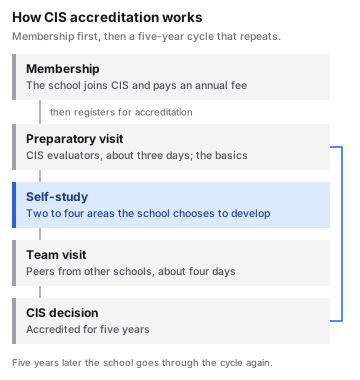
The preparatory visit by CIS evaluators "generally lasts for three days". In the self-study, the school works on two to four development initiatives tied to the CIS standards and its own plans, and sends in evidence. A team of volunteer peer evaluators, who are teachers and leaders from other member schools, then visits for about four days. Schools repeat the cycle every five years. Our guide to CIS accreditation covers the stages in more detail.
ACS WASC, which has accredited schools since 1962, judges a school against its own stated purpose rather than a set curriculum. That is why IB, British and American schools can all hold it; see our WASC guide. NEASC says it works with more than 1,600 schools in over 90 countries. Its international commission requires a preliminary visit, a self-evaluation and a visiting team before it accredits a school.
British Schools Overseas (BSO) works differently. It is the UK Department for Education's voluntary scheme. An approved inspectorate inspects the school against the BSO standards, and "maintaining BSO accreditation is conditional on a school having an inspection every 3 years." The two approved inspectorates are Education Development Trust and the Independent Schools Inspectorate. Penta International was dropped from the list in July 2026, so some older BSO reports carry its name. The department publishes each accredited school's latest report.
CIS, WASC and NEASC don't grade or rank the schools they accredit. Their decision is whether a school is accredited, sometimes with conditions attached. It shows the school met a standard, but not how it compares with others. BSO is the exception. Its inspection reports use English inspection grades, so one school's report may call its teaching "good" and another's "outstanding". That makes BSO reports the most useful of the four for comparing schools.
Membership
A membership body exists to serve its schools. It offers teacher training, conferences, sports and arts events for pupils, job boards and safeguarding guidance. What it asks of a school before letting it in varies a great deal.
CIS does both. A member school pays "one annual fee" that gives its staff access to training and networking. Membership on its own is not accreditation. CIS says more than 745 of its member schools are engaged with its accreditation, and a school has to be a member before it can apply.
The East Asia Regional Council of Schools (EARCOS) admits regular members in East Asia that "meet all membership standards of the Council" and have operated for at least three consecutive years. Its page for regular members does not mention accreditation. Schools outside the region that join as affiliates must show a current accreditation letter from a body such as CIS, COBIS, NEASC or WASC.
At the other end are associations that admit only schools another body has already inspected. The Federation of British International Schools in Asia (FOBISIA) requires full members to undergo "re-accreditation by an approved international inspectorate at least every five years". St Joseph's Institution International School Malaysia, for example, moved from associate to full member in July 2026 after Education Development Trust accredited it in March 2026. Our guide What is FOBISIA? explains how schools join.
The Council of British International Schools (COBIS) admits schools through its own quality assurance or through accreditation from another body it accepts. Its membership page lists accredited members whose inspection came from CIS, BSO, ISI, WASC, NEASC or OEAS. A school that says "COBIS Member" rather than "COBIS Accredited Member" has usually passed a lighter compliance check on safeguarding, welfare, premises and governance, without anyone observing lessons. COBIS describes its scheme as "not a pass/fail regime, nor a one-off snapshot". Our COBIS guide sets out each status.
Curriculum authorisation: the IB, Cambridge and Pearson
The IB, Cambridge International and Pearson are exam boards or curriculum bodies. When one of them approves a school, it has checked that the school can teach its programmes and run its exams.
To become an IB World School, a school moves from interested school to candidate to authorised school, with an evaluation visit before authorisation. Japan's IB consortium, run with its education ministry, says this "usually takes two to three years", and there is a fee to apply for candidacy. Our guide to the IB explains the programmes themselves.
Cambridge International registers schools in four steps: an expression of interest, an application form, an approval visit and a contract letter. Signing that letter completes registration and gives the school access to Cambridge resources and training. Pearson approves schools as Edexcel centres in much the same way, for its International GCSEs and International Advanced Levels. A school can be a registered Cambridge or Pearson centre while holding no whole-school accreditation at all.
Operating licences
A licence to operate comes from the government where the school sits. Some governments also inspect schools.
Dubai's Knowledge and Human Development Authority restarted full inspections of private schools in the 2026-27 school year after a two-year pause, and schools now get no more than 24 hours' notice of a visit. A full inspection ends with a published overall rating. Few regulators in Asia publish anything comparable, which is one reason families there rely on accreditation.
What heads and parents think
Ask heads who have been through accreditation and most will say the value is in the preparation: a year or more in which staff look hard at their own school and fill the gaps they find.
For membership of regional school groups, the value is in the teacher training and the inter-school events their pupils go to.
Parents who have moved between several schools tend to say a missing accreditation is worth a question, and doesn't mean the school is not as good as another. That is particularly true of younger schools. Accreditation costs money and staff time, and a young school may simply not have reached the stage where it makes sense yet. EARCOS, for one, waits until a school has run for three years.
Checking yourself
Check with the accreditor. The UK government, for example, publishes every BSO school's latest inspection report. A school that holds an accreditation will usually share the outcome, though the detailed report may stay private.
Our profiles list each school's accreditations and memberships. These are the schools we profile that hold CIS accreditation:
| School | Curriculum | Fees a year (USD) |
|---|---|---|
| Hong Kong (3) | ||
| Chinese International School | IB | 34,400–53,100 |
| Hong Kong Academy | IB | 19,200–39,000 |
| Stamford American School Hong Kong | American · IB | 28,000–35,000 |
| Jakarta (3) | ||
| Australian Independent School Indonesia | Australian · IB | 5,580–24,500 |
| British School Jakarta | British · IB | 8,790–31,100 |
| Jakarta Intercultural School | American · IB | 16,900–35,100 |
| Kuala Lumpur (4) | ||
| HELP International School | British | 6,170–16,200 |
| IGB International School | IB | 12,400–29,000 |
| The Alice Smith School | British | 13,200–30,000 |
| The International School of Kuala Lumpur | American · IB | 17,200–35,100 |
| Singapore (7) | ||
| Anglo-Chinese School (International) | British · IB | 24,600–34,000 |
| Australian International School | Australian · IB | 24,500–43,100 |
| Dulwich College (Singapore) | British · IB | 29,300–46,300 |
| St Joseph’s Institution International | IB · British | 31,200–40,000 |
| Stamford American International School | American · IB | 24,100–43,900 |
| UWCSEA Dover Campus | IB · British | 34,600–43,100 |
| UWCSEA East Campus | IB · British | 34,600–43,100 |
Our schools with Council of International Schools
FAQ
What is the difference between accreditation and membership?
Accreditation means an outside body has inspected the school against written standards and will do so again on a cycle. Membership means the school has joined an association; some associations require accreditation first and others do not.
Is CIS membership the same as CIS accreditation?
No. A CIS member pays an annual fee for training and networking; a CIS accredited school has also completed the preparatory visit, self-study and team visit and is re-evaluated every five years.
Is an IB school accredited?
IB authorisation approves a school to teach IB programmes after a candidacy that usually takes two to three years. It is separate from whole-school accreditation, though many IB schools hold both.
Does FOBISIA or COBIS membership mean a school has been inspected?
FOBISIA full members must be re-accredited by an approved inspectorate at least every five years. COBIS members have passed either COBIS's own check or another body's accreditation, and the label says which.
Is BSO the same as being regulated by the UK government?
No. BSO is a voluntary Department for Education scheme with an inspection every three years, but the department has no jurisdiction over schools outside England.
Should I avoid a school with no accreditation?
Not automatically. Check its government licence, how long it has been open and whether it is a candidate for accreditation, and ask to see any inspection or evaluation report.
Sources
- British schools overseas: accreditation process and support, GOV.UK, Department for Education
- British schools overseas: inspection reports for accredited schools, GOV.UK, Department for Education
- International Accreditation Cycle, Council of International Schools
- School Membership Community, Council of International Schools
- Accrediting Commission for Schools, ACS WASC
- Home, NEASC
- Membership, East Asia Regional Council of Schools
- Apply for Affiliate School Membership, East Asia Regional Council of Schools
- SJIIS Malaysia achieves full FOBISIA membership status, St Joseph's Institution International School Malaysia
- Membership, COBIS
- COBIS Patron's Accreditation and Compliance, 5 years on, COBIS
- To become an IB World School, IB Consortium, Japanese Ministry of Education
- Step 4: Become a Cambridge School, Cambridge International
- Pearson Edexcel International Welcome Pack, Pearson
- KHDA inspection changes for Dubai private schools: what to expect in 2026-27, Khaleej Times
More in Accreditation
More- 16 October
Accreditation
Dubai school heads prepare for KHDA inspections at 24 hours' notice
Inspectors return to Dubai's private schools this term after a two-year pause, and the ratings they give will shape what schools may charge.
Dubai
Dubai · 16 October
- 15 October
Explainer · Accreditation
What is FOBISIA?
Member schools, how a school joins, and what membership means for pupils, teachers and parents.
15 October

- 13 October
Explainer · Accreditation
The Council of British International Schools (COBIS), a quick overview
COBIS member, accredited member, and BSO status. How COBIS works
13 October
- 1 October
Explainer · Accreditation
What is the Council of International Schools (CIS)?
What CIS accreditation means, the process, and difference between membership and accreditation
1 October